
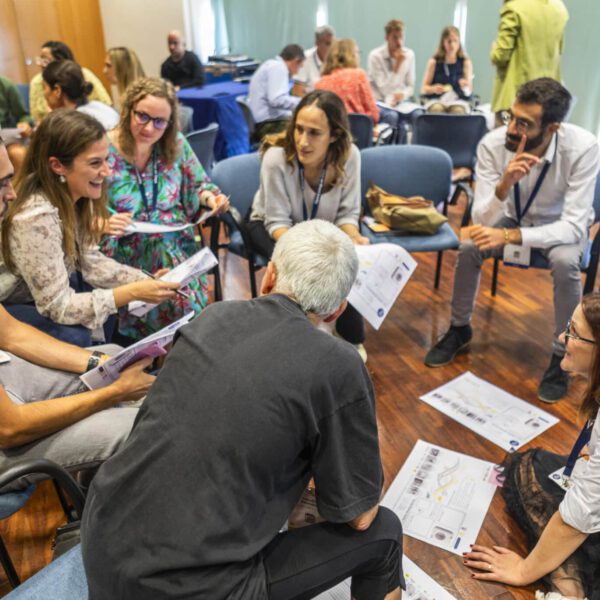
Image credits: IDEA League
Transfer and Transformative Change in and through Living Labs: From Practice to Theory, and back again
08 – 12 June 2026
A five-day Summer School – including an international conference with leading scholars and practitioners, interactive workshops and site visits – that challenges and enables students to advance the theory and practice of Living Labs for knowledge transfer and value-oriented transformative change.
Keywords: Living Labs, Open Science, Open Innovation, Regulatory Sandboxes, Knowledge Transfer, Transformative Change, Transdisciplinary Research, Real-World Experimentation, User-Centred Innovation, Ethics, Sustainability, Digitalisation
Location
Aachen, Germany
Participants
Application is open to Master and PhD Students of the member universities from the IDEA League Alliance.
Preference will be given to PhD students from IDEA League partner universities who are already working with or interested in open science and open innovation processes in and through Living Labs.
Expenses
There are no tuition fees or accommodation fees. Lunches and official social activities will also be covered. Students from IDEA League member universities selected to participate in this summer school only have to pay for their own travel costs where applicable.
Requirements
– Curriculum vitae & publications list
– Letter of motivation (max. 300 words)
– Letter of recommendation (optional)
– Transcript of records (for master students)
– Supervisor approval (for PhD candidates from Chalmers)
The Summer School “Transfer and Transformative Change in and through Living Labs: From Practice to Theory, and Back Again” offers participants a unique opportunity to explore how open science and citizen/user-centred innovation practices in Living Labs can and do drive societal transformation. Over the past two decades, Living Labs have become established as paradigmatic infrastructures for transdisciplinary, participatory research and real-world experimentation, connecting research, business, industry, public authorities, and citizens.
Across Europe, Living Labs are increasingly recognised as critical for addressing complex challenges such as sustainability transitions, digital inclusion, and health. They are sites of exploration, experimentation, and application as well as arenas for mutual learning, knowledge transfer, technology development, and systemic change. EU-level initiatives, including the EU AI Act and EU Missions, position Living Labs as central environments for policy-driven experimentation and co-creation, and the European Network of Living Labs (ENoLL) highlights their role in linking research, innovation, and societal impact.
This Summer School invites participants to engage with questions such as:
How can multiple Living Labs converge into coordinated ecosystems and pathways for transformative change?
Using examples from the Rhenish Region and beyond, the programme explores contributions Living Labs can make to strategic, systemic transformation in decarbonisation, digitalisation, and socio-economic development. By combining theory, practice, and policy perspectives, the Summer School deepens understanding of Living Labs as infrastructures for knowledge transfer, co-creation, and transformative change across Europe.
Schedule
On Monday morning, the Summer School begins with an introductory session that familiarises participants with the overall goals, structure, and the group assignment of the week, introduces the organising team, and creates a space for participants to get to know each other.
From Monday afternoon to Wednesday noon, Summer School participants will take part in an international conference on knowledge transfer and societal transformation in and through Living Labs, organised and hosted by the Living Labs Incubator of RWTH Aachen University. Summer School participants may submit abstracts to the organising team for possible inclusion and presentation at the conference via LLI@humtec.rwth-aachen.de. (Please note that abstract submissions are only possible until 27 March 2026. More information and the Call for Contributions can be found on the conference website.)
The second part of the week focuses on hands-on experiences and collaborative learning:
On Wednesday afternoon, participants will discuss impressions and key learnings from the conference.
On Thursday morning, student groups will work collaboratively on their group assignment through two interactive workshop sessions, followed by a field trip to the “temporary university Hambach” (tu! Hambach 2026) in the afternoon. At this pop-up space for collaborative learning and knowledge exchange, located near an open and still-operating lignite mine, Summer School participants will experience first-hand what structural change means for a region. Together with local citizens, representatives from policy and city administrations, as well as students and researchers from various fields and institutions, they will reflect on the potential role of Living Labs in such processes.
On Friday, participants will present the results of their group assignment, which integrates theoretical and practical perspectives, to their peers and faculty.
Learning Objectives
- Understand the theory and practice of Living Labs
- Learn about methods and settings for knowledge transfer in and through Living Labs
- Explore open science and user-centred innovation
- Develop skills in transdisciplinary collaboration
- Reflect on ethical, epistemological, and societal challenges